

By Sylvia Marek

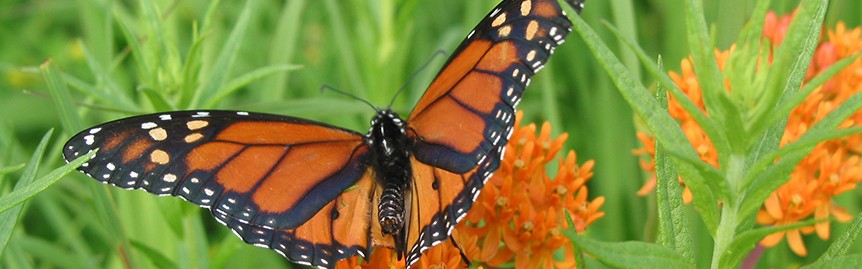
Monarch on butterfly weed
Phenology is a science focused on observing and recording biological events from year to year and their relationships to the change of seasons and climate.
These are the “normal” phenology events we expect to see here and in the Madison area this month. We would love to hear about what you are seeing on the grounds of Holy Wisdom Monastery. Please comment on this post with what you are observing, where at Holy Wisdom and the date you observed the event.
July Phenology
“The tall grass prairie…. from the first greening of spring to the full ripening of autumn,
it is spangled by a vivid progression of flowers—a rainbow host that first enamels the
burned slopes of early spring and ends months later with great nodding blooms
that rise above a man’s head.” –John Madison, “Where the Sky Began”
July is usually the warmest and sunniest month of the year. Nesting season is over for most bird species, but not all. Colorful prairie flowers bloom profusely among green grasses. Peak month of activity for butterflies, moths, bees, beetles, bugs, crickets, grasshoppers, dragonflies, damselflies, spiders, and twinkling fireflies at night. There is so much to enjoy in July.
Following, are some of the happenings I have observed over the years.
Birds
- American goldfinch and cedar waxwing begin to nest in late June into July.
- Some species start second broods: cardinal, bluebird, house wren, mourning dove,
house finch, indigo bunting, song and field sparrow, and a few others. - Listen for parental calls and scolds and the noisy begging of fledglings.
- Nesting season is over for most species. They start to molt and sing less often
during the day. - However, I have heard the following sing very early in the morning: wood
thrush, red-eyed vireo, indigo bunting, flicker, wood-pewee, and including those
who have second broods. - Swallows gather in flocks.
- A few warblers such as yellow, common yellowthroat, and Nashville begin to head
- Shorebirds start their southward migration.
- Red-breasted nuthatches often show up in July and leave.
- Female turkeys lead their flocks of young on foraging outings.
- Red-tailed hawks soar over the prairie.
- Great horned, barred and screech owl juveniles are able to fly now. They hunt on
their own but continue to beg for food.
Plants
Timing of the July parade of flowers can vary from year to year due to a number of environmental conditions. I have noticed that some species bloom earlier or later between late June and early August. Some bloom for longer or shorter periods of time. They might be taller or shorter than normal.
Woodlands, savannas, and edges
- Plants in bloom include: purple Joe-Pye-weed, downy woodmint, pale Indian-
plantain, tall bellflower, yellow giant hyssop, figwort or purple giant hyssop, figwort,
woodland tick-trefoil, enchanter’s nightshade, white avens, lopseed, jumpseed,
white snakeroot, stickseed, bedstraw species, native heal-all, tall or woodland
thistle, thimbleweed, agrimony, spreading dogbane, woodland sunflower, the
Susan’s—black-eyed (Rudbeckia hirta), cut-leaved coneflower, (R. laciniata), brown-
eyed (R. triloba), tinker’s weed (horse gentian), yellow jewelweed, and bottlebrush
Prairie
- Controlled burns are an effective way to set back native invasive shrubs such as
gray dogwood and sumac. Burns usually stimulate most forbs and grasses to
flourish and bloom. - Week after week the parade of prairie flowers include as many as 12 or more
different species displaying yellow, purple, blue, white, pink, orange, and red blooms.
Yellow:
- yellow coneflower, Coreopsis palmata and C. tripteris, ox-eye sunflower,
black-eyed, sweet black-eyed, and brown-eyed Susans, cup-plant, compass-plant,
prairie-dock, rosinweed, evening primrose, Canada milk-vetch, cinquefoil species,
saw-tooth sunflower, sneezeweed, stiff sunflower, hawkweed, giant St. John’s-wort,
grass-leaved, early or Missouri goldenrod.
Purple:
- pale purple and purple coneflower, leadplant, purple prairie clover, monarda (beebalm), Liatris species, hoary vervain, germander, Canada tick-trefoil, ironweed, anise or purple hyssop, and purple milkweed.
White:
- rattlesnake master, wild quinine, Culver’s root, white prairie clover, white indigo, whorled milkweed, boneset, upland boneset, flowering spurge, pale-Indian plantain, mountain mint, marbleseed, New Jersey tea, Indian hemp, fleabane, bush clover, yarrow, thimbleweed, tall meadow-rue, water- hemlock, cowbane, and white sage.
Blue:
- Great Blue lobelia, harebell, blue vervain and a few last spiderwort.
Pink:
- common and swamp milkweed, biennial gaura, prairie or field thistle, Illinois tick-trefoil, nodding wild onion, and spreading dogbane.
Orange:
- butterfly milkweed, Turk’s cap lily, and jewelweed (Impatiens biflora).
Red:
- cardinal flower
- Take time to smell the sweet fragrance of monarda, common and swamp milkweed,
the coneflowers, pale Indian-plantain, mountain mint, and roses. - Have you noticed every year a different species will produce large patches of showy
flowers? Then for several years those plants are scattered and fewer of them bloom?
I do not know why. Perhaps they are annuals, biennials, short-lived perennials,
or new plantings? What about fire, competition, a dry or wet year?
Introduced or invasive species
- Chicory, Queen-Anne’s lace, common daisy, pokeweed, crown-vetch, bird’s-foot
trefoil, yellow and white sweet clover(Melilotus), hedgeparsley, leafy spurge,
white campion, motherwort, creeping bellflower, common St. John’s-wort,
bittersweet nightshade, Canada and bull thistle, non-native heal-all, wild parsnip, and
Insects
- July is the peak flight period of over 30 species of butterflies and skippers. They
include: monarch, comma, wood nymph, Eastern tiger and black swallowtail,
fritillary species, red-spotted purple, viceroy, crescent and checkerspot species,
spring azure, Eastern tailed blue and other hairstreaks, red admiral, painted lady,
clouded sulphur, cabbage white, silver spotted skipper and other skippers. - The annual Madison Audubon (now Southern Bird Alliance) butterfly count is usually
held around July 4. - Moths are very numerous and active day and night. Some of my favorites are
Virginia ctenucha, grape leaf folder, white-striped black (near or on jewelweed),
tiny common black and white spring moth (host plant, black locust) and eight-
spotted forester (host plant, Virginia creeper). - Peak season for dragonflies and damselflies.
- Beetles can be seen everywhere. There are many kinds of lady, leaf, fungus, soldier,
long-horned, and tiger beetles. - The beautiful iridescent dogbane leaf beetle (Chrysochus auratus) can still be seen
on Indian hemp and spreading dogbane. Do not confuse it with the Japanese
beetle (Popillia japonica). They are also iridescent but have five with tufts of hair
on the edge of their abdomen. They are native to Japan and No. China. They feed
on over 300 plants and are quite destructive especially in July. - Bugs such as milkweed, boxelder, stink, assassin, and many others are numerous.
- Listen for the rhythmic chants, trills, chirps, lisps, and tics of katydids, grasshoppers,
and crickets. Bees buzz and hum. Cicadas make loud pulsating sounds. Snowy
and black-horned tree crickets are my favorite insect musicians. - At night, enjoy the blinking and twinkling of fireflies.
Arachnids
- Deer ticks seek blood meals and can transmit Lyme and other diseases.
- Chigger or harvest mite larvae cause extreme itching (stay on trails).
- Spiders are beneficial and beautiful. Take time to admire the creativity of spiders
especially when their webs are covered with sparkling dew or raindrops. The
yellow garden spider spins a beautiful, large, circular, vertical web. She often
remakes it after a few days. - Crab spiders are adorable. They do not spin webs, but sit on flowers and ambush
their prey. Some change colors to match the flower. - Jumping spiders are so cute. They do not spin webs. They have excellent eyesight
and pursue their prey by jumping.
Mammals
- Many of the following youngsters are active: gray squirrel, chipmunk, raccoon,
opossum, ground squirrel, woodchuck, coyote (at night), and all sizes of rabbits. - Mole activity increases.
- Antlers of male deer (bucks) are reaching peak size and are in the pulpy, velvet
- Fawns still follow their mothers (does).
- Only a few bats can be seen at night. Sadly, there are fewer bats now due to the
white-nose syndrome, a fungus that has killed millions of North American bats.
Other natural happenings
- Common elderberry shrubs bloom now. The white umbrella-like flowers fill the air
with sweet perfume. - Fragrant basswood flowers attract myriad insects especially buzzing bees.
- Buttonbush blooms and the small globes of white flowers attract many insects.
- The fragrant white water-lily blooms on ponds.
- Listen for the tremolo call of the gray and Cope’s tree frog. The green frog sounds
like the plunking of a banjo. Bull frogs have a deep “jug-o-rum” call. - Look for toads of all sizes.
- There is plenty of “healthy” native poison ivy.
- Mushrooms pop up after rainy periods.
- Migratory Bird Treaty was passed July 3, 1918.
Enjoy your visit as you hike the trails through this beautiful and well-cared for land. And let us be grateful for the sister’s and for those who work to preserve and restore this precious land.
“To those who see…miraculous sights and envision all of the wonders hidden from the eye…. hear multitudinous sounds and listen to the symphony that silence brings.” –Gwen Frostic, “To Those Who See”
Sylvia Marek
Sylvia Marek is a highly trained and experienced naturalist. She works for the University of Wisconsin Arboretum and is a first-rate birder.
Please share the biological events you notice while at Holy Wisdom Monastery below (remember to include what you see, where and when).
Comments 1
I love this column [or is it called a “blog” in more modern pixel/gigabyte terminology, please be patient with us, the older electronically challenged elders] and was wondering, for those of us who are not blessed to be near enough the Holy Wisdom to relay sightings there, might you also be interested in any of the phenology events and experiences we might notice in our neck of the woods? I’d be interested in hearing/reading about the phenological diversity of the various places around the world. Just a thought.