

By Sylvia Marek
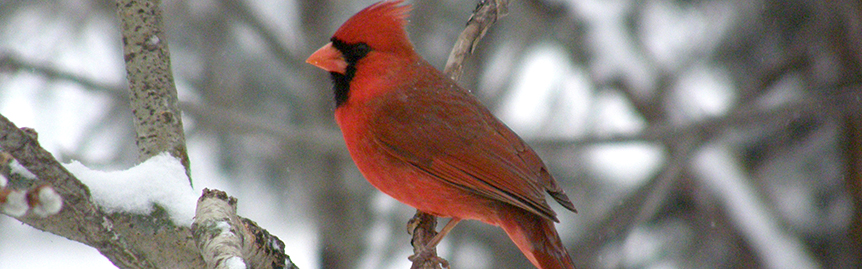
Male cardinal at Holy Wisdom Monastery
Phenology is a science focused on observing and recording biological events from year to year and their relationships to the change of seasons and climate.
These are the “normal” phenology events we expect to see here and in the Madison area in January. We would love to hear about what you are seeing on the grounds of Holy Wisdom Monastery. Please comment on this post with what you are observing, where at Holy Wisdom and the date you observed the event.
January Phenology for Holy Wisdom
“Go softly on your way. Learn to be a gentle people and seek joy in simple things.” –Anonymous
January, the coldest month of the year with frigid wind chills, snowstorms, ice, sleet, and freezing rain. Usually we experience a January thaw, but when it occurs is unpredictable. “Each year, after the midwinter blizzards, there comes a night of thaw when the tinkle of dripping water is heard in the land” (Aldo Leopold). I wonder how the changing climate will affect weather patterns and plant and animal life? January is a month of long, cold nights and twinkling stars. Daylight is noticeably longer, and the sun sets later each evening.
“January observation is almost as simple and peaceful as snow, and almost as continuous as cold. There is time to not only see who has done what, but to speculate why.” –Aldo Leopold from Sand County Almanac
Following are some of my favorite January observations.
Resident Birds
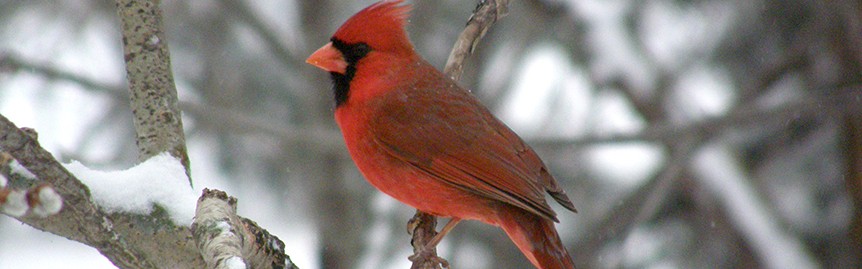
- Male and female Cardinals remain in flocks. They look brighter because the tips of their feathers are wearing off. Cardinals call “what cheer, wet year” early in the morning. Near the end of January, males and females sing throughout the day.
- Blue Jays add color to the winter landscape.
- Chickadees flit about in small flocks. Listen for their sweet “fee-bee” song associated with spring.
- Tufted Titmice call “Peter, Peter.”
- White-breasted Nuthatches search for insects in cracks and crevices of tree bark. Listen for their nasal “yank, yank” call and their one-pitch “wa, wa, wa, wa” call.
- Flocks of Goldfinches search for seeds in the prairie and along edges of woods.
- Downy, Hairy, and Red-bellied Woodpeckers can be heard tapping on trees as they search for insects. Listen for their loud drumming associated with territory and courtship.
- Male Mourning Doves start long-cooing songs in late January.
- Flocks of House Finches warble and House Sparrows chirp.
- Look for flocks of Cedar Waxwings consuming crabapples, red cedar cones and sumac fruits.
- Foraging flocks of Turkeys roam the land.
- Crows gather in noisy flocks.
- The Red-tailed Hawk soars over the prairie hunting for small mammals.
- The Cooper’s Hawk hunts the savanna and woodland for small birds.
- Great Horned Owls are one of the earliest birds to breed in Wisconsin. Listen for the duet calls of the male and female. The female uses an abandoned hawk or crow nest to lay her eggs in late January or February.
- Barred Owls continue to call and ask “who cooks for you?”
- Some years a few birds that spent the summer here, do not migrate south. Look for Robin, Bluebird and Flicker feeding on sumac and other fruits.
Winter Visitors
- Look for the Brown Creeper spiraling around tree trunks in search of insects.
- Flocks of Dark-eyed Juncos and Tree Sparrows search for seeds in the prairie and along edges.
- Most years Purple Finch, Golden-crowned Kinglet, and flocks of Pine Siskin spend the winter. Red-breasted Nuthatches also visit. They can be heard uttering a slow nasal “na, na, na, na” and a soft “ip, ip, ip” as they search for insects on tree trunks.
- It is possible to see Northern Shrike, Rough-legged Hawk, and Northern Harrier hunting over grasslands. Others to look for include Saw-whet and Long-eared Owls in wooded areas and short-eared and snowy owls in open areas.
Irregular Visitors from the North
- Many of the following birds breed in Canada and are uncommon or nomadic. They feed on tree buds, seeds, fruit, and some mainly eat conifer seeds. When food is scarce because of fires, logging, or other unknown causes, look for the following:
- White-winged and Red-winged Crossbill
- Evening and Pine Grosbeak
- Bohemian Waxwing
- Common and Hoary Redpoll
Mammals
- Most are active at night. Tracks (patterns) and prints (marks) in the snow tell stories of their nocturnal activities. If there is no snow or mud, look for the following clues: scat (droppings), tunnels, travel lanes, tooth marks, browse, bones, fur, feathers, pellets, blood, nests, and caches of food.
- Rabbits hop or leap. Their front feet land just behind their rear feet. Their paired tracks form an arrow which points to the place where the rabbit was coming from. Rabbits browse woody plants leaving a sharp 45-degree angled cut. They also gnaw bark. Rabbit scat resembles brown m & m’s.
- Gray squirrels also hop and leap. Front feet land behind hind feet and often disappear near a tree trunk. Males frantically chase females through treetops and mate.
- Raccoons mate in January. They have five slender toes on each foot. Front feet resemble our hands, and hind feet resemble our feet.
- Opossums wander the land when it is not too cold. Hind tracks resemble our hands with the thumb pointed down. Their front tracks show five toes and is star-shaped.
- Coyotes and foxes have four toes on each foot. They walk or run in almost a straight line. Dogs meander.
- White-footed mice can climb trees, and they use abandoned nests and nest boxes. Their tracks are paired with a trail drag between. They make beautiful, delicate, embroidery-like tracks.
- Meadow voles and shrews make meandering tracks that remind me of a beaded necklace. They make tunnels under the snow and through the grass. They gnaw tree and shrub bark.
- Deer tracks resemble a heart. Deer droppings look like a pile of brown marbles. They lack upper incisors and rip branches leaving a ragged edge. Male white-tailed deer shed antlers usually in January.
Insects and Spiders
- Those that do not migrate or die, spend the winter as adults, partially grown adults, larvae or eggs. Some adult insects emerge when temperatures are above 32 degrees.
- On warm, sunny days look for snow fleas or springtails. They resemble tiny, dark, poppyseeds and gather in large groups on snow, tree trunks, or leaves. They mate and/or eat algae on old snow.
- Fungus gnats, midges, box elder bugs, lady bird beetles, some butterflies, and others are active on warm days.
- Wingless winter crane flies mate. They resemble mosquitoes and do not bite.
- Tiny dwarf spiders climb up and off leaf litter. They walk on the snow looking for a mate or food.
And More Favorites
- Glittering, lacy, white hoarfrost. Look for it during a humid morning following a cold, clear night.
- “Beautiful star crystals, perfect little wheels, six perfect leaflets, fern-like snow stars.” Thoreau. Try to find one exactly like the one you are holding in your hand.
- Ice crystals sparkle like colorful jewels in the sunlight.
- Sapsicles hanging from broken branches.
- Lichens are made up of an alga growing inside a fungus. There are about 30 common species in Wisconsin. Look closely at these lovely green, gray, and yellow fairylands on rocks and tree trunks.
- Colors and shapes of buds and seeds.
- Green conifers and the fragrance they emit.
- Tree silhouettes and contours of the land.
- Bright twinkling stars and January constellations.
- Peace and silence of a winter night.
As you walk the trails, take time to appreciate the silence and beauty of this land that
is cared for with love.
Sylvia Marek
Sylvia Marek is a highly trained and experienced naturalist. She works for the University of Wisconsin Arboretum and is a first rate birder.
Please share the biological events you notice while at Holy Wisdom Monastery below (remember to include what you see, where and when).
Comments 2
Hi Sylvia,
I was very excited to see two adult and what I think were two juvenile bald eagles flying above the monastery on Tuesday and Wednesday around 4:15 in the afternoon. I looked for them again today, with binoculars ready, but no luck.
Thank you Syvia for putting forth the effort to publish the phenology. I look forward to it and always learn something.