

By Sylvia Marek

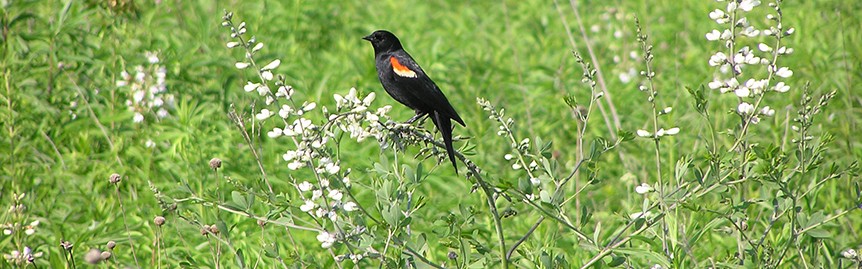
Red-winged blackbird on white wild indigo
Phenology is a science focused on observing and recording biological events from year to year and their relationships to the change of seasons and climate.
These are the “normal” phenology events we expect to see here and in the Madison area this month. We would love to hear about what you are seeing on the grounds of Holy Wisdom Monastery. Please comment on this post with what you are observing, where at Holy Wisdom and the date you observed the event.
I have kept monthly phenology records for many years and the following are from my June entries. Some events occur in late May also.
“Deep in the grasses of summer sing the lives I love.”
Theodore Roethke
June
June, a month of sweet birdsong, nest building, nestlings learning to fly, active young mammals, myriad insects and the sounds they make. Plants grow rapidly producing lush shades of green. Each week a dozen or more flowers bloom on the prairie adding bright colors to the landscape. Native shrubs and trees bloom. Fruits and seeds ripen. The summer solstice is June 21, the longest day and shortest night of the year. And, there is so much more for you to enjoy.
Birds
- Most of the spring migrants that breed farther north have passed through.
- Resident and summer visitors sing, mate, and raise young. Many of the following
have nested here, at Governor Nelson Park and surrounding areas. Look for
Robin, Chickadee, White-breasted Nuthatch, Tufted Titmouse, Blue Jay, House Finch,
Mourning Dove, Woodpeckers (Downy, Hairy, Red-bellied, Red-headed, and Flicker),
Swallows (Tree, Rough-winged, Bank, and Barn), Sparrows (Chipping, Field, Song,
and Swamp), Warblers (Common Yellowthroat, Yellow, and Redstart), Bluebird, House
Wren, Sedge Wren, Rose-breasted Grosbeak, Towhee, Indigo Bunting, Flycatchers
(Great Crested, Willow and Least), Vireos (Warbling and Red-eyed), Wood Pee-wee,
Wood Thrush, Phoebe, Cedar Waxwing, Red-winged Blackbird, Scarlet Tanager,
Kingbird, Oriole, Hummingbird, Red-tailed and Cooper’s Hawk, Mallard, Wood Duck,
Killdeer, Crow, Turkey and of course, many more. Please add to my list and check
eBird for what other birders have seen. - Great Horned, Barred and Screech Owl young continue to beg and now practice
flying. - Goldfinch can be heard and seen but usually nest in late July.
Plants
Woodlands:
- Flowers can bloom a few weeks earlier or later than usual due to changing weather
patterns. - Peak bloom of native sun-loving spring flowers is over.
- Native flowers that usually bloom in late May and early June include: wild
geranium, wild columbine, Virginia waterleaf, violets, Jack-in-the-pulpit, starry
false Solomon’s seal, Solomon’s-plume, Solomon’s-seal, yellow and white avens,
black snakeroot, enchanter’s nightshade, baneberry, bedstraws, sweet cicely,
honewort, blue cohosh, jewelweed, and trillium. - Introduced and ecologically invasives include: dame’s rocket, garlic mustard, greater Celandine poppy (Chelidonium magus).
Prairies and Savannas:
- June is a great month to enjoy the parade of floral beauty that will continue all
summer and fall. Each week a dozen or more species will display their flowers
creating a patchwork of lovely colors. - Blue: lupine, spiderwort, pale spike lobelia, harebell, and blue-eyed grass.
- White: white wild indigo, penstemon digitalis, Culver’s root, strawberry, white
prairie clover, flowering spurge, fleabane, yarrow, thimbleweed, tall meadowrue,
cow parsnip, wild quinine, bedstraws, glade mallow, New Jersey tea, pale
Indian-plantain, Indian hemp, and Canada anemone. - Yellow: prairie or creamy wild indigo, golden Alexander, black-eyed Susan, tall
and sulphur cinquefoil, St. John’s-wort, coreopsis, ox-eye (Heliopolis helianthoides),
golden ragwort, yellow coneflower, rosin weed, pimpernel, evening primrose,
puccoon, and yellow star grass. - Purple: pale and purple coneflower, common milkweed, purple prairie clover,
lead-plant, monarda, prairie phlox, hoary vervain, wild garlic, large-flowered
beardtongue, and heal-all. - Orange: butterfly milkweed and wood lily.
- Pink: roses, spreading dogbane, and swamp milkweed.
Trees, Shrubs, Brambles, and Vines:
- Many usually bloom in late May and in June.
- Trees: basswood and non-native black locust bloom. Their flowers are very fragrant.
- Shrubs: arrowwood, ninebark, common elderberry, staghorn sumac, fragrant sumac,
dwarf honeysuckle, and the dogwoods (gray, silky, and red-osier). - Brambles: blackberry and black raspberry.
- Vines: poison ivy, woodbine, bittersweet, and the very fragrant flowers of grape.
- Fruits: Juneberry, wild strawberry, blackcap raspberries, and the poisonous
red elderberry.
Insects
- Monarch butterflies return from the South, lay eggs, and die. Their caterpillars
fed on milkweed, pupate, emerge as adults, and start a new generation. - Other butterflies to look for include tiger swallowtail, black swallowtail, spring
azure,Eastern tailed-blue, fritillary, pearl crescent, painted lady, viceroy, hackberry,
cabbage white, clouded sulphur, wood nymph, American copper, silver-spotted
skipper, and many more. - Giant silk moths emerge in mid-June usually at night. They mate, lay eggs, and
live only a few days. Look for cecropia, promethia, polyphemus, and possibly the
more rare luna. - Smaller moth species are active both day and night. Tent caterpillars emerge from
cocoons and devour leaves. They spin cocoons, pupate, and emerge weeks
later as a small brown moth. - The white-striped black moth is very small and one of my favorites. Look for the
beautiful little moth especially near jewelweeds. - Dragonflies hatch and patrol for mosquitoes and other insects.
- Look for grasshopper nymphs as well as adults.
- Field crickets chirp and a few katydids and cicada can be heard.
- There are many different kinds of active beetles, bugs, and bees. Look for June or
May bugs, tiger beetles, ambush and stink bugs, ladybugs (beetles), aphids,
leafhoppers, treehoppers, lovely lacewings, and many more. - My favorite iridescent dogbane beetle (Chrysochus auratus) feeds only on
Indian hemp or spreading dogbane. The beautiful shiny native “jewels” usually
emerge in mid-June. Do not confuse them with Japanese beetles (Popilla
japonica). They are also iridescent but have five white tufts of hair or spots
on the edge of the abdomen. They are native to Japan and China and feed on
over 300 kinds of plants! They emerge from underground near the end of June. - Black, deer, and horse flies bite.
- Female mosquitoes feed on blood and are fed upon.
- Peak month to enjoy the blinking and twinkling of fireflies at night.
Spiders
- Spiderlings hatch. Orb weavers and their webs are quite small now.
- Jumping spiders and crab spiders are tiny and very cute.
Mammals
- June is a good time to look for the following curious, active, young mammals:
gray squirrel, chipmunk, rabbit, raccoon, opossum, woodchuck, ground squirrel,
skunk, mink, muskrat, fox, coyote, and mice. - Spotted fawns follow does.
- Deer shed gray winter fur and grow a red-brown summer coat.
- Look for velvet-covered antlers on male deer.
- Bats are active at night catching insects.
Other Natural Events
- Listen for the calls of Cope’s and gray tree, leopard, and green frogs. Toads
continue to “purrrr” and trill. Toad tadpoles are in various stages of development. - Painted turtles lay eggs in soft soil.
- Several kinds of sedges bloom in June
- Needle, June, and blue-joint grass bloom. Ecologically invasive reed canary blooms.
- The following introduced or naturalized plants are in bloom especially on disturbed
ground: white ox-eye daisy, chicory, goatsbeard, hawkweeds, and Queen Anne’s –
lace. Ecologically invasives include wild parsnip, leafy spurge, yellow and white
sweet clover (Melilotus sp.), and hedge-parsley. - Ferns unfurl and are lovely.
- Conifers shed pollen.
- Cottonwood seeds in cottony down float through the air (reminds me of snow).
- After rainy weather look for the following mushrooms: destroying angel, shaggy
mane, marasmius, bolete, Dryad’s saddle, sulphur or chicken of the woods,
oyster, and more.
“I would like to enjoy the summer flower by flower.”
Andre’ Gide
Holy Wisdom is a place I enjoy and love very much. My hope is that you will love it also and that you will discover things I have missed. –Sylvia Marek
Sylvia Marek is a highly trained and experienced naturalist. She works for the University of Wisconsin Arboretum and is a first rate birder.
Please share the biological events you notice while at Holy Wisdom Monastery below (remember to include what you see, where and when).
Comments 1
Lovely, thank you!