

By Sylvia Marek

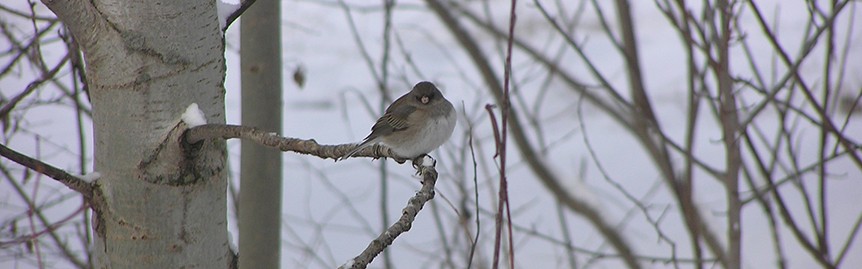
A junco in the woods at Holy Wisdom Monastery
Phenology is the science of observing and recording plant and animal activities from year to year and their relationship to season and climate. The following Madison area observations are from notes I have kept over the years. We would love to hear about your observations here at Holy Wisdom. Please comment on this post what, where, and the date of your observations.
December Phenology
“I heard a bird sing in the dark of December.
A magical thing and sweet to remember.” –Oliver Hereford
December, a month when the gray, black, brown and tan landscape of late autumn changes into a wonderland of white and silver beauty with a few sprinklings of color. It is usually a month of cold temperatures which can create a variety of pretty snowflakes, frost, glittering hoarfrost, sparkling ice and sometimes freezing rain. In the future, December might be warmer, wetter or possibly colder due to the changing climate. Year-round resident birds and visitors from the north form mixed feeding flocks and give fragments of song. And owls call at night. The annual Christmas Bird Count is held in mid-December. The first count started in 1900. During the first half of December, the sun sets around 4:15 pm. According to the calendar, the winter solstice or the beginning of winter occurs on December 21 or 22, the shortest day and longest night. Brilliant winter constellations include Orion, Big Dipper, Pleiades and Cassiopeia.
The following are some of my favorite observations.
Birds
- Birds that use the area throughout the year include the following: Cardinal, Chickadee, Blue Jay, White-breasted Nuthatch, Goldfinch, Tufted Titmouse, Mourning Dove, House Finch, House Sparrow, Cedar Waxwing, Red-bellied, Downy and Hairy Woodpeckers, Red-tailed and Cooper’s Hawk, Turkey and Crow. Resident male and female Great Horned Owls call frequently during territorial formation and courtship. Their soft duet calls can be heard especially around dusk and before dawn. Look and listen for the barred owl asking, “who cooks for you?” Please do not play recordings to attract them and do not disturb them in any way.
- Birds that arrive from the north and spend the winter include Brown Creeper, flocks of Dark-eyed Juncos and Tree Sparrows. They are predictable.
- Other winter visitors from the north are unpredictable. The following birds visit most winters but not all: Pine Siskin, Red-breasted Nuthatch, Purple Finch, Golden-crowned Kinglet, Fox, White-throated and White-crowned Sparrows, Northern Shrike, Rough-legged Hawk and Snowy Owl. Saw-whet, Long-eared and Short-eared Owls often show up in or around the Madison area. Rarely do the following visit: Redpoll, Evening Grosbeak, Pine Grosbeak, Red and White-winged Crossbill and Bohemian Waxwing.
- Occasionally, overwintering Robins, Bluebirds and Cedar Waxwings can be seen feasting on crabapples, red cedar cones and sumac fruits.
- Look up and listen for migrating Tundra Swans, Canada and Snow Geese, Sandhill Cranes and Gulls. Waterfowl leave when ice forms on ponds and lakes.
- As climate changes, wintering ranges of many species might change.
- How many abandoned bird nests, woodpecker holes, owl pellets and areas of whitewash can you find?
Mammals
- Gray squirrels are active during the day. Look for their large leafy nests high up in trees. They use them in the summer. They usually use tree cavities in the winter. Flying squirrels are nocturnal and use cavities in trees.
- Deer browse woody plants. They lack upper incisors and tear branches and twigs. Look for “buck rub.”
- Rabbits have upper and lower incisors. They browse or cut twigs and small branches diagonally or at a sharp 45-degree angle.
- Meadow voles gnaw bark off woody plants. They also eat grass and other types of plant material such as roots, leaves, seeds and mushrooms. They make holes in the ground and tunnels through grass and snow.
- Shrews scurry frantically across trails.
- Deer and white-footed mice are active at night and leave delicate tracks in the snow. They find shelter in abandoned bird nests or bluebird boxes
- Other mammals to look for include coyote, raccoon, opossum, mink, weasel, red fox and possibly gray fox. They are usually active during the night and leave their tracks or scat on the mud or snow.
Insects
- Where are the insects? Many spend the winter as adults, semi-adults, larvae or eggs. Most are in a dormant state.
- Adult ladybird and other beetles, boxelder and other bugs, and other insects seek shelter under logs, rocks or plants. A few species of grasshoppers overwinter as adults. Most grasshoppers lay eggs for future generations.
- Butterflies that overwinter as adults include red admiral, mourning cloak, comma and question mark. A few can be seen fluttering about when it is at least 50 degrees.
- Viceroy butterflies overwinter as a partially grown larva in a rolled-up leaf attached to a branch.
- Cabbage whites overwinter in a grayish-green chrysalis.
- The two-inch hairy cocoon of the cecropia moth is attached horizontally on a branch. The promethea cocoon resembles a dry gray leaf hanging from a twig on a silken stalk. Years ago, I found cocoons on black cherry, apple, willow and box elder. They are not very common now and not easy to find.
- Look carefully for glossy, foam-like egg masses of the tent caterpillar especially on cherry and apple trees. Watching chickadees search can help you locate the eggs.
- Snowy tree crickets prepare for future generations by inserting eggs here and there on twigs and small branches.
- The female black horned tree cricket lays her eggs in a short line of little holes. I have found them on the stems of blackcap raspberries and other small twigs.
- Many native bees and other insects use plant stems as an adult, larva or egg. For that reason, I do not cut my plants down in winter.
- Galls are abnormal growths on plants. There are three common galls found on goldenrod stems. The ball gall (larva of a fly), elliptical gall (moth), and bunch gall (midge). There are 800 kinds of galls on oaks. Look for oak bullet gall on white oak twigs, oak hedgehog on leaves, oak apple on black and red oak and so many more. Enjoy your search for galls.
Spiders
- Many species of spiders overwinter as adults. Some spend the winter as eggs or little spiders in papery egg sacs attached to plants. Others tuck their sticky egg sacs behind loose bark or under rocks.
Arachnids
- Ticks hopefully lie dormant in leaf litter.
Colors of December
- Shades of black, gray, brown and tan dominate the landscape. Notice tree bark, rocks, dried leaves, pinecones, plants, seeds and grasses.
- Conifers, mosses and lichens add lovely shades of green, gray and yellow. Have you noticed the beautiful grayish-greenish-yellowish lichens growing on trees and rocks? There are 30 common lichens found in Wisconsin. The three types are crustose (like paint), foliose (leaf-like) and fruticose (fruiting bodies).
- Blue cones (fruits) decorate female red cedar trees. Bluish-lavender stems of blackcap raspberries stand out. Young branches of boxelder trees are light bluish-gray.
- Red and orange crabapples, rose hips, sumac fruits, stems of red-osier dogwood and small flocks of all-red male cardinals and buffy-brown females add a bright sprinkling of color.
And More Favorites
- Dark silhouettes of trees, especially oaks, against a blue or gray sky.
- All sizes, shapes and colors of buds and seeds.
- Turkey tail fungus attached to dead wood with rings of various colors. Artist’s bracket fungi are also attached to dead wood.
- Milkweed pods with silver and gold linings.
- Sparkling snowflakes, frost and glittering hoarfrost.
- Lovely sunsets and sunrises.
- The view of Lake Mendota and the prairie from the high hilltop.
- May you find quiet beauty, love and peace here at Holy Wisdom.
“What makes a place special is the way it buries itself inside the heart, not whether it’s flat or rugged, rich or austere, wet or arid, gentle or harsh, warm or cold, wild or tame. Every place, like every person, is elevated by the love and respect shown toward it.” –Richard Nelson, from Island Within
This place is loved!
Sylvia Marek
Sylvia Marek is a highly trained and experienced naturalist. She is also a long-time volunteer at the University of Wisconsin Arboretum and is a first-rate birder.
Please share the biological events you notice while at Holy Wisdom Monastery below (remember to include what you see, where and when).
Comments 3
While not right at the monastery, my husband and I saw over 80 tundra swans last weekend in a bay of Lake Mendota at Governor Nelson State Park, across the road from the monastery. Thanks for helping us confirm our sighting!
Thank you, Holy Wisdom Family, for offering us another gift and invitation to gently, quietly recognize our God of all-being moving/migrating among us on this gracious earth which is temporarily our shared home. A home wherein we are here being reminded that we can deepen our awareness of the Divinity pulsating within us and within some of the most fragile, courageous beings of foot or wing, bark or dormant grain surrounding us. When I opened this site, I was soothed by the loving and watchful gaze of the Junco. It is as if I am right there next to my friend the Junco, settled, feather-fluffed for warmth, on that graciously provided branch/perch with this full chested bird sojourner gazing at the course of the world.
Thank you so much for reminding me of all the quiet beauty of the prairie no matter the season!